Peace Practices+Management+Foundation Report 2015
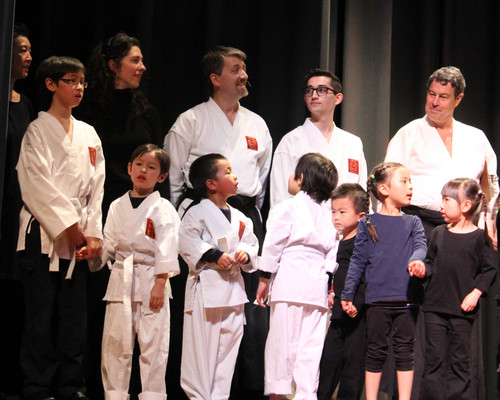
We have been overwhelmed by the enthusiasm with which opportunities for growth continue to come our way. Even people with exposure only to the ideas at play, and with no training yet themselves, are asking to purchase products displaying our logo and recommending the curriculum to their friends. We have more requests for additional programs than we can respond to adequately. The faculty at Pacific Rim International School report that the children ask almost every day if "today will be a Peace Practices day" and use the techniques in daily interactions. With an abundance of enthusiasm for the Peace Practices program and a wealth of potential sites, it will be more critical than ever in the coming year to screen and train qualified instructors and staff, as well as build the necessary organizational infrastructure so we can grow into these opportunities.

You have asked what we might do differently, if it were possible to undertake this project again from the beginning. We would shift emphasis in two areas. Most of our fundraising allotment would be deployed earlier to secure a devoted professional contractor. We initiated long term, low initial yield strategies, like product sales, while waiting to have more evidence of our growing success and, as a result, fell short of our targets. Our recent and ongoing fundraising success makes us feel very hopeful for our future efforts. Had I known how things would play out, I would also have devoted a significant amount of attention very early to the Board of Directors development we have now completed.
For an itemized budget of actual expenses and income for the project, including a complete accounting of how the specific dollars were spent, please see the Funding Deployment section below. Using the original budget from our proposal as requested, we have provided a narrative to put variances in context and indicate the presence of the many families who have stepped up to support this project. This report includes links to online resources which demonstrate our fulfillment of requirements. To facilitate your viewing of the online resources until the funding approval process is complete, the most recent version of this report will be available online at
http://abcglobal.net/Peace_Practices_Report
The future of Peace Practices is very bright. Our next developmental phase will involve ongoing funding, expansion, and replication of our program both within and without sites officially affiliated with our organization. The work is catching on. Not only are professional educators clamoring for the training and organizations are asking to integrate Conflict Done Well into their group cultures, but individuals are also experimenting with our founding principles on their own, which we consider to be a significant sign of approval. This we have created with your help, and it is only the beginning.
Looking forward,
Brandon Williamscraig Ph.D.
for the ABC and Peace Practices team
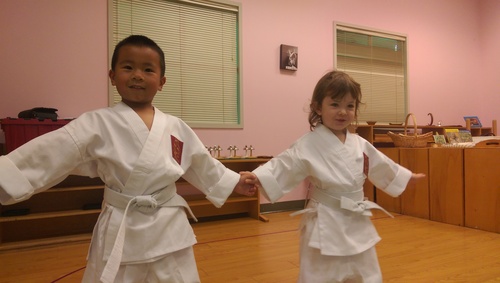
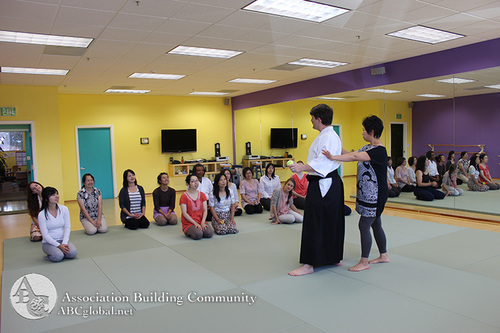
Since May of 2014, following your first investment, we have seen 248 new faces practicing peace with us. Peace Practices classes have grown from just three classes a week in Berkeley to fifteen classes a week in Berkeley, Emeryville, and San Mateo. Back in their academic classrooms, teachers are watching even our three and four year old students use the Martial Nonviolence at the heart of Peace Practices to resolve conflicts through partnership and harmony, in place of more common reactions that depend on win-lose competition. Pacific Rim International School (PRINTS) staff have noted changes to children's behavior in their otherwise repetitive quarrels. Through the custom Peace Practices curriculum built for the PRINTS Montessori community, children have learned and continue to practice methods of mindfulness and balance while being challenged with confrontation and conflict both in physical and verbal form. Seventeen of nineteen potential faculty members have participated in our classes. We have enjoyed having them practicing peace with us, and have observed them providing leadership by example in the classroom as well. Last Fall we held an introduction for the faculty members so that they might learn the goals of each major component of the activities in the Peace Practices classes. In this session we were able to introduce faculty to exercises, aspects of which they would soon see appearing in the classroom, and showcase the full potential of this work through a live demonstration by two of our instructors. One PRINTS faculty member, who also has a Master's Degree in conflict studies, opted to join not only in every possible class during the year, but also participates in our quarterly training seminars so that she may become a full Martial Nonviolence Instructor. Since October we have designed and offered classes specifically for adults and have invited all PRINTS faculty, staff, and parents, as well as members of the surrounding community. Several parents join us in afternoon classes with their children, and a few have come to our adults only classes, but not in the numbers we had hoped. Discovering what will motivate more parents to join in training is one of our primary local goals for 2015-2016. Of the obstacles that the program has faced, the recruitment and training of suitable instructors has been one of the biggest challenges. It has taken more time than expected to secure and prepare two assistant instructors, both of whom continue to train in Martial Nonviolence and the unique structure of the Peace Practices curriculum. This has impacted the work that Association Building Community has been able to accomplish, since the need for Brandon Williamscraig's frequent teaching and instructor training has meant less time for administration and program development. In order to offset this impact, ABC contracted with an assistant to expand management coverage and free Brandon to work more on recruitment and training. The children and adults of Pacific Rim International School who joined us in May 2014 know they are working toward a vision of learning and practicing "conflict done well" through this one-of-a-kind Peace Practices program. Parents report that their children bring uplifting options home from school and apply strategies they didn't even know were available several months ago. Staff members frequently report that the children studying Peace Practices are using the language of Martial Nonviolence to resolve everyday conflicts and successfully navigate the troubled and troubling waters of disagreement. Here is an example from an email we received: Alyssa (4 years) and Kiera (5 years) had an incident that I want to share with you. Both wanted to be the one to put a single bike back in the storage shed. They could not agree. One bit the other, and that one bit back. Both were hurt physically (though it was very hard to see) and emotionally, since they have been good friends for a long time. Both of them cried hard, and did not want to talk about it. I initiated a conversation with them in order to ask why they were feeling frustrated, and recommended that they deal with their feelings by using words. Kiera suddenly said, "Oh, yes, just like the Peace Practices class! When someone tries to push you, you take their hand and say 'let's go together'." I asked if each might say something like that to the other, and both of them said they would say "let's do it together" or "let's go together." Then Alyssa said "But Sensei said we also need to practice so it can be part of us." I asked them how they would practice this, and they asked me to stage the bike in its original place so that they might run to the bike and practice with gentler words. I did so and they said ''let's go together' and "let's do it together" to each other. When they put the bike back, they stared at each other for a moment, smiled, and hugged. Much appreciation to Brandon Sensei who makes a lot of effort in working with the children. Your support makes this kind of transformation possible! I can't say enough how proud we are of the children, and grateful for your investment in their future.PROJECT DELIVERY

As of December 2014 Reporting and Evaluation of Agreed Metrics
IMPACT MEASUREMENT
What follows is the narrative requested to accompany the full accounting of funds in the line item report below. It puts our financial choices in context, especially if there was a more than 10% difference between our projection and the actual amount spent. The information here follows the guidelines you provided and the sequence of the financial chart that. We requested $100,000 per year for three years, and received $80,000 via our Union Bank of California account in May of 2014. As agreed, we deployed these financial resources toward project work, capital expenditures, and administration. In the original proposal we mentioned two private donors we hoped would support our work financially, but neither was able to do so due to circumstances beyond their control. Spending on instruction fell within expected parameters, while the cost of local travel, including vehicle maintenance, public transit, fuel, and tolls, was considerably higher than expected. In the area of special events and dojo rental, all funds budgeted were saved by deploying volunteer and administrative time to find free community resources. Likewise, we provided all instruction in-house and saved all moneys put aside for hiring guest instructors. Our founder and chief instructor, Brandon Williamscraig is, by definition, also the primary curriculum developer and was able to keep that area well within budget by securing volunteer expert consultation, and deployed his relationships in or with other organizations to cultivate organizational partner curriculum development without committing major resources. This will probably prove to have been a less than ideal choice, in consideration of the need for an early start on longer term project growth, but resulted in a considerable savings. Website and social media development went very well indeed. We invite you to visit us on Facebook (https://www.facebook.com/peacepractices), Twitter (http://twitter.com/peacepractices), and Tumblr (https://www.tumblr.com/blog/peacepractices). The overage in local travel, mentioned above, was more than compensated for by significantly reducing the airline travel expected and doubling focus on our local area. These cost cutting measures will not be possible going forward but, though difficult, they proved to be our best choices in the first year. Likewise, the initial Study Director stipend was repurposed, and the work was done in-house when our candidate opted out, the majority of the work being ably taken up by our staff. Regarding capital expenditures, the floor mats to create dojo/training hall space were an excellent purchase and fell within expected budget parameters. By doing all the fundraising ourselves, however, we saved money but underperformed each month, until very recently. We've learned not to make that mistake again but, on the other hand, it was a good decision to shift the majority of bookkeeping tasks in-house, relying on our external contractor for larger-scale systems work and C-level consultation. Our savings on insurance was possible because we continue to negotiate for a policy which will truly cover our growing needs. We expect those negotiations to conclude about the same time as the new round of funding. Given our minimum project operating expenses of $100,000 a year, and funding limited to $80,000, we began to economize immediately and rely on the things which we do well and know are required for overall success. As a result we have good results to show in all areas but fundraising. This area of inadequate performance is our acknowledged area of greatest growth potential. It is there we must focus in the coming months and years in order to continue our otherwise successful endeavor. We must also hire instructors and get them ready to launch new sites. Our instructor recruitment goals for the first year have not been met to the degree that we anticipated in 2014, drawing more of Brandon's time and energy to teaching and recruiting than to fundraising. In 2014, we raised 27% of our total. As a result, Brandon reformed the ABC Board of Directors so that recruitment of higher-level fundraisers may become a priority. We have managed our seed funds well and will meet our obligations through May, until we receive the next round of funding. We have also launched a Crowdrise campaign at https://www.crowdrise.com/peacepractices which continues to bring in donations and improve our financial outlook for 2015, currently bringing in more than 15 times the funds we were able to raise last year at this same time. and look forward to the following in 2015-2016: Remaining budget items needing funding: We continue to report our progress to Christinia Cheung on an at least monthly basis, and are happy to provide additional information of any kind at any time. Since your original investment has been fully deployed, we will be able to make good on our financial obligations through the end of this month, and hope that we will hear from you soon if you are in need of any clarification or additional information. We also hope to hear any recommendations for our improvement, or about any advisors or donors who might help us move our project forward. We will check in on a weekly basis and make sure the online resources are available for your evaluation at http://abcglobal.net/Peace_Practices_Report until we hear from you that all is well and the process is moving forward. For all the children and adults you are helping to practice peace, thank you so much for all that you continue to make possible! With profound gratitude, Brandon Williamscraig Ph.D. CEO, Association Building Community FUNDING DEPLOYMENT
Funds Distribution
Area
Specifics
Projected
Actual
Variance
% var
Instruction
under/over budget
Instructors, Assistants, Apprentices, & Interns
$62,530.00
$57,013.29
$5,516.71 under
8.82%
Local travel costs including fuel, tolls, etc.
$1,690.00
$2,714.51
$1,024.51 over
60.62%
Special events dojo rental
$1,690.00
$0.00
$1,690.00 under
100.00%
Guest Instructors
$845.00
$0.00
$845.00 under
100.00%
Total
$66,755.00
$59,727.80
$7,027.20 under
10.53%
Curriculum
Primary Developer
$5,914.00
$5,538.65
$375.35 under
6.35%
Expert Consultation
$1,268.00
$0.00
$1,268.00 under
100.00%
Organizational Partner Curriculum Development
$1,268.00
$0.00
$1,268.00 under
100.00%
Website and social media development
$2,535.00
$2,352.97
$182.03 under
7.18%
Travel
$2,535.00
$1,262.19
$1,272.81 under
50.21%
Total
$13,520.00
$9,153.81
$4,366.19 under
32.9%
Study
Study Director Stipend
$3,380.00
$852.10
$2,527.90 under
74.79%
Study Admin Assist
$845.00
$877.84
$32.84 over
3.89%
Total
$4,225.00
$1,729.94
$2,495.06 under
59.05%
Instruction Curric & Study Subtotal
$84,500.00
$70,611.55
$13,888.45 under
16.44%
Capital Expenditure
Floor mats to create dojo/training hall space
$5,500.00
$5,890.00
$390.00 over
7.09%
Total
$5,500.00
$5,890.00
$390.00 over
7.09%
Administration
Fundraising
$5,000.00
$3,801.50
$1,198.50 under
23.97%
Bookkeeping
$3,000.00
$1,321.14
$1,678.86 under
55.96%
Insurance
$2,000.00
$0.00
$2,000.00 under
100.00%
Total
$10,000.00
$5,122.64
$4,877.36 under
48.77%
Projected
Actual
Variance
% var
Required to operate Peace Practices project
$100,000.00
$81,624.19
International Foundation Funding
$80,000.00
$80,000.00
Campaigns and Appeal Donations
$2,543.97
as of 20150430
ABC Membership Recurring Donations
$3,007.00
Merchandise sales
Break-even
-$23.78
Total Funds Raised
$20,000.00
$5,527.19
$14,472.81
72.36%
